

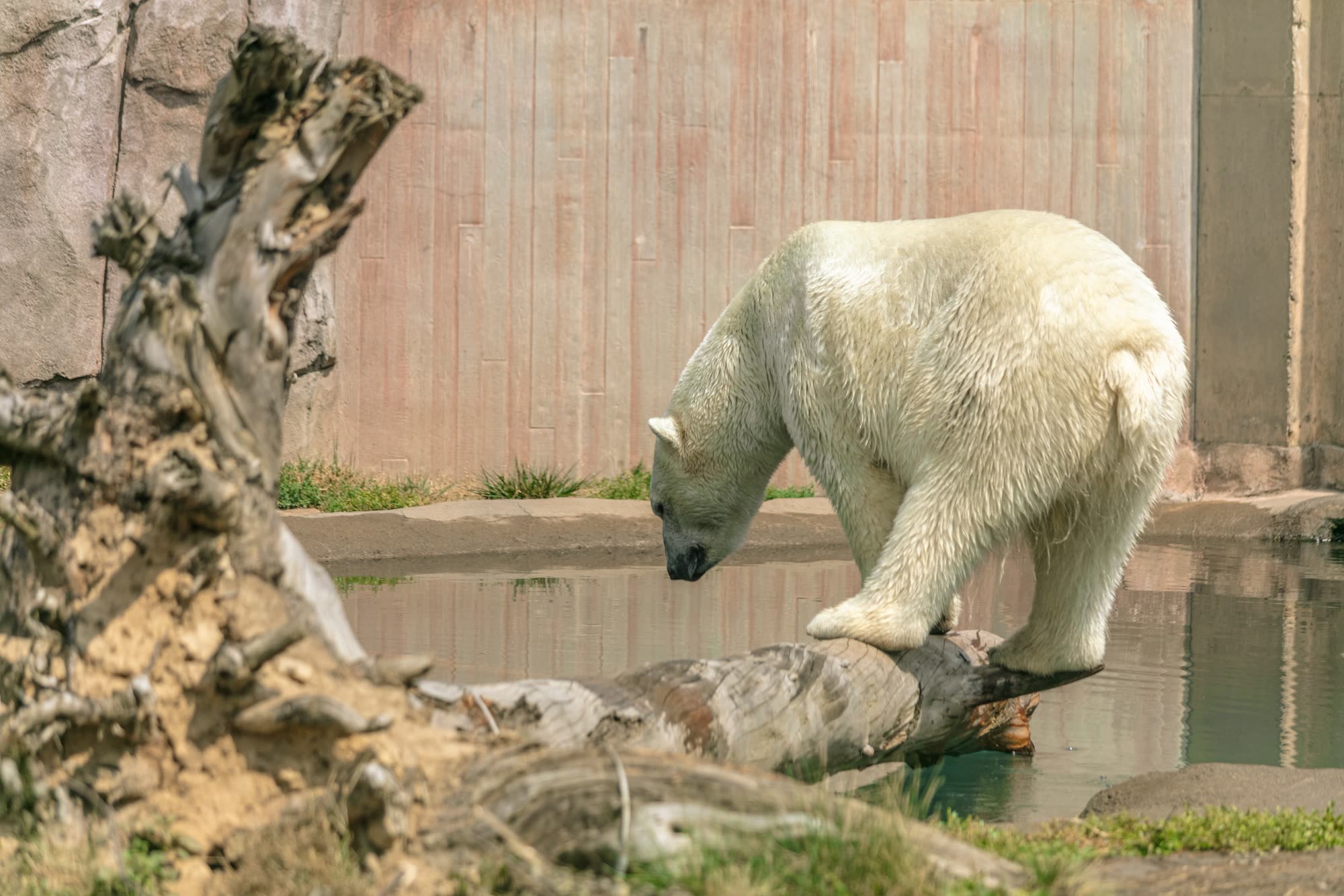
Zoos and husbandry
Polar bears in zoos: husbandry, benefits and criticism
Should polar bears live in zoos? This has been debated for years. Here you will find what studies show, what zoos and animal welfare groups argue and how to judge husbandry conditions.
400–500 m²
minimum outdoor area for a pair of polar bears: 400 m² (4,300 sq ft) in Germany (mammal report, 2014), 500 m² (5,400 sq ft) of dry land recommended by the AZA in North America
14%
of the day, zoo polar bears on average pace up and down the same routes (study of 20 zoos)
≈ 1 : 1,000,000
enclosure area compared with the home range of wild polar bears (according to press reports on the 2003 study by Clubb & Mason)
101
polar bears in facilities of the European zoo association EAZA (July 2023)
The essentials
Both sides in brief
Experts do not agree. Some key points are well documented, however:
Species with very large home ranges show abnormal repetitive behaviour and higher cub mortality more often in captivity. The polar bear is one of the examples (comparison of 35 carnivore species, Clubb & Mason 2003).
A study of 55 polar bears in 20 North American zoos found large differences between facilities. With more enrichment, group housing and a view outside, the animals paced the same routes less often (Shepherdson et al. 2013).
Zoos point to research, education and the European Endangered Species Programme (EEP). Animal welfare groups such as the German Animal Welfare Federation (Deutscher Tierschutzbund) and the UK charity Born Free, on the other hand, consider species-appropriate keeping of polar bears hardly possible and call for giving it up or phasing it out.
Zoo polar bears are not released into the wild and do not increase the wild population. For wild polar bears, sea ice and climate action are what matter.
What studies show
What research says about zoo husbandry
Comparison of carnivores (2003): Ros Clubb and Georgia Mason (University of Oxford) analysed data on 35 carnivore species in captivity. The larger a species' natural home range and the longer its daily travel distances, the more often it showed repetitive movements such as pacing in captivity, and the higher its cub mortality. According to press reports on the study, a typical polar bear enclosure is about one millionth the size of a wild animal's home range. Clubb and Mason concluded that the keeping of such species should be fundamentally improved or ended. The data date from the period up to 2003.
Polar bears in North American zoos (2013): David Shepherdson and colleagues studied 55 polar bears in 20 zoos for a year. On average the animals paced the same routes for 14% of the day, which equals 22% of their time spent moving. Differences between animals and facilities were large. It happened less with more enrichment, more animals in the group and a view out of the enclosure; training with positive reinforcement (rewarding wanted behaviour) also seemed beneficial. Higher levels of stress hormone breakdown products in droppings went along with more pacing and a smaller land area.
Limits of what the evidence shows: A review of welfare indicators for zoo polar bears (Animal Welfare) notes that the evidence often rests on few animals and that validated measuring methods are missing. How to interpret stress hormone levels is also disputed: whether such measurements prove that animals are not suffering is contested, according to the German Animal Welfare Federation.
What zoos argue
Research, education and conservation breeding
Zoos and their associations give three reasons for keeping polar bears.
Research
With zoo animals, observations and samples can be collected repeatedly. According to EAZA and Polar Bears International, this allows studies that are difficult or risky in the wild. These include blood and hair samples given voluntarily for hormone, nutrition and health studies and the development of pregnancy tests. Fastenings for tracking collars are also tested before use on wild bears, and activity sensors for the Arctic are checked.
Education
Zoos want to reach people who would not otherwise see a polar bear, and to inform them about sea ice and climate change. In a survey of over 6,000 visitors in 30 zoos and aquariums (Moss et al. 2015, all species), the share of respondents with a recognisable understanding of biodiversity rose from 69.8 to 75.1%. The share with knowledge of conservation measures rose from 50.5 to 58.8%. Whether this leads to lasting changes in behaviour is open: a follow-up analysis found only a weak link, and older studies were criticised on methodological grounds (Marino et al. 2010).
Conservation breeding
The European Endangered Species Programme (EEP) for polar bears has existed since 2006 and coordinates breeding and animal exchange between zoos. In North America, the Association of Zoos and Aquariums (AZA) has run a Polar Bear Species Survival Plan since 2004. It now treats the zoo polar bears as a research population: trained bears take part voluntarily in studies that are meant to help wild polar bears. In July 2023, 101 polar bears lived in facilities of the zoo association EAZA. Release into the wild is not planned: the German Animal Welfare Federation points out that zoo animals of species such as the polar bear are not intended for that.
Polar Bears International stresses that no zoo can offer the conditions of the wild; appropriate keeping is possible, however, through structured enclosures and enrichment.
What critics argue
Space, behaviour and offspring
The German Animal Welfare Federation does not reject zoos in principle, but considers the polar bear a species that zoos should not keep. The UK charity Born Free calls for an end to breeding and imports and for polar bear keeping to be phased out (report “Born to Roam”, 2023: 151 polar bears in European zoos, 12 of them in the UK). PETA goes further in its criticism.
Space and way of life
Wild polar bears roam areas of thousands to tens of thousands of square kilometres a year and hunt actively on the sea ice. Even enclosures that exceed the minimum sizes are very small by comparison. Animal welfare advocates conclude that polar bears can hardly be kept in a species-appropriate way.
Behaviour
Pacing, head-swinging or swimming the same laps over and over in zoo polar bears is seen by animal welfare advocates as a sign that needs are not being met. In their dissenting statement (dissenting opinion) on the 2014 German mammal report, representatives of animal and nature protection groups called frequent pacing a clear indication of continuing suffering.
Offspring
Hand-rearing is not recommended by zoo umbrella organisations, among other reasons because of the risk of faulty imprinting, but according to animal welfare groups it occurs regularly. For cub mortality in zoos, reporting on the 2003 study gave a figure of about 65% (data as of 2003).
Legal framework
The mammal report of the German Federal Ministry of Food and Agriculture is a guideline for the authorities of the German states and is not legally binding. The Animal Welfare Federation calls for binding and stricter requirements. Animal welfare and zoo associations took part in the 2014 revision; both recorded their dissenting views in their own dissenting opinions. In the USA, the federal Animal Welfare Act sets legally binding minimum standards for polar bear enclosures, for example a pool at least 1.5 metres (5 feet) deep with a surface of at least 9 square metres (97 square feet). The AZA care manual recommends going well beyond these minimums.
Minimum sizes
Minimum sizes in Germany and North America
In Germany, the 2014 revision of the mammal report doubled the minimum outdoor area for a pair of polar bears to 400 m² (4,300 sq ft). North American zoos must follow the US Animal Welfare Act and, if accredited by the Association of Zoos and Aquariums (AZA), a stricter care manual. The main requirements compared:
Topic
Germany (mammal report, 2014)
North America (AZA and US law)
Outdoor enclosure
At least 400 m² (4,300 sq ft) for a pair, 150 m² (1,600 sq ft) more for each additional adult
AZA: 500 m² (5,400 sq ft) of dry land for one or two bears, 150 m² more for each additional bear
Water pool
At least 100 m² (1,080 sq ft) water surface; depth at least 2 m (6.6 ft) or volume at least 200 m³ (7,000 cu ft)
AZA: a pool of 70 m² (750 sq ft) with a deep end of at least 3 m (10 ft). US law: at least 9 m² (97 sq ft) and 1.5 m (5 ft) deep
Indoor enclosure
Separate boxes that can be connected
AZA: an off-exhibit area of at least 75 m² (810 sq ft) for two bears, plus 25 m² (270 sq ft) for each additional bear
Equipment
Retreats and visual cover, bedding for nest building
AZA: soft ground instead of concrete, a planted landscape, a pool, and places where the bears can avoid public view
Legal status
Guideline without the force of law; the state authorities assess individual cases
The Animal Welfare Act sets legally binding minimums; the AZA care manual recommends going well beyond them
Judging husbandry
What to look out for on a zoo visit
These points come from the mammal report and the studies mentioned. They are a guide, not a seal of quality.
Are there retreats and visual cover, so the animals can withdraw from visitors' view?
How big and deep is the water pool? A depth of at least 2 m is intended.
Is food scattered, hidden or frozen into blocks of ice, so the animals have to search for it?
Do the animals have a view outside? In the 2013 study, animals with a view paced the same routes less often. The same applied to housing in groups; in nature, however, polar bears mostly live alone outside the mating season.
Does an animal walk the same route, swing its head or swim the same laps for long periods? That is considered a warning sign.
Does the zoo train the animals with positive reinforcement, that is, with rewards, for example for voluntary examinations? In the study this also tended to prove beneficial.
Snapshot
A visit shows only a glimpse
Behaviour changes during the day and with the season. Anyone who wants to know more can ask the zoo about husbandry, breeding and the transfer of animals.
Development
Two zoos have ended polar bear keeping
According to media reports (2025), around 30 polar bears still live in zoos in Germany. Some zoos have stopped.
2018
Wilhelma Stuttgart
After the death of the polar bear Corinna, the Wilhelma did not continue keeping polar bears. In 2020, it explained that the enclosure could only be converted into a modern, future-proof facility at enormous cost. The former polar bear facility was converted into a cheetah facility in 2021.
2021
Grüner Zoo Wuppertal
After more than 100 years, polar bear keeping ended. The zoo said the old facility was too small, and a new building was not affordable. The last polar bear, Anori, moved to an outdoor facility of about 3,000 m² in Mulhouse (France).
Knut and Flocke
Two famous zoo polar bears
Knut was born on 5 December 2006 at Berlin Zoo. His mother rejected her twins; one cub died after four days, Knut survived in an incubator and was raised by the keeper Thomas Dörflein. He became a worldwide media phenomenon. Knut died on 19 March 2011 after an epileptic seizure made him fall into the water pool; he drowned. In 2015, anti-NMDA receptor encephalitis was identified as the cause of the seizures, an autoimmune disease previously known only in humans (Scientific Reports, DZNE, IZW, Charité).
Flocke was born on 11 December 2007 at Tiergarten Nürnberg (mother Vera, father Felix). The mother repeatedly dropped the cub; keepers therefore hand-reared it from 8 January 2008. Because hand-reared polar bears are later less able to raise their own young, the zoo had deliberately not intervened at first.
Context
What remains to be said
Whether keeping polar bears in zoos is justifiable depends on weighing animal welfare, educational benefit and species conservation. This page presents the arguments of both sides. Developments elsewhere show how varied the picture is. In Scotland, the Highland Wildlife Park keeps polar bears in an enclosure of about four acres (around 1.6 hectares), described by the park as one of the largest in the world. Mercedes, then the only polar bear in the UK, moved there from Edinburgh Zoo in 2009 and was put to sleep in 2011 because of her failing health. A cub born at the park in 2017 was the first in the UK for 25 years; Born Free criticised the decision to breed.
Keep reading
You may also be interested in
Arctic habitat
Where polar bears live and how their population is spread across 20 subpopulations.
How polar bears are protected
Climate action, patrols, agreements, protected areas and research.
Questions and answers
The most common questions about polar bears, answered briefly and with sources.